Software AI
Agentic Testing with Playwright
LLM-guided agents can explore UIs, author Playwright specs, and triage failures—if you anchor them in stable selectors, hermetic environments, and deterministic replay.
What agentic testing adds
Beyond record-and-playback, agents can traverse new builds using product maps, propose negative paths from acceptance criteria, and cluster failures by DOM signatures or network errors. The value is iteration velocity on coverage—not removing humans from release decisions. Agents excel at boilerplate navigation and repetitive regression expansion; they still struggle with subtle visual regressions unless paired with snapshot discipline and baselines.
Pair LLM planning with Playwright's deterministic execution: the model proposes intents; the runner enforces timeouts, strict mode, and assertions that must pass in CI—not merely "looked fine" in a demo browser.

Environment and data strategy
Ephemeral preview environments per branch with seeded fixtures beat shared staging for agent scale. Seed scripts should be idempotent and fast; agents multiply setup cost. Clock control, feature flags, and network stubs help reproduce order-dependent flows. Document which datasets are safe for autonomous crawling—never point agents at production-like PII without contractual clearance.
- Reset state between scenarios; prefer API setup hooks over UI-only prep when possible.
- Tag tests by risk tier: smoke vs. full regression; agents should not inflate smoke duration unbounded.
- Capture HAR only when compliant; redact tokens from traces stored in artifact buckets.
Flakiness, timing, and trust
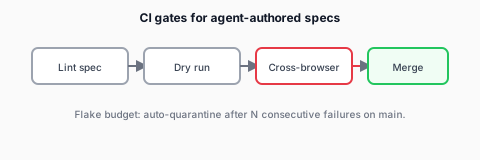
Agents amplify timing bugs if waits are implicit. Standardize on Playwright auto-waiting, web-first assertions, and explicit expectations for network idle where appropriate—knowing that global network idle can be a footgun on SPAs. When an agent edits a test, require green runs on targeted browsers in policy and attach the trace zip for reviewer download.
- Maintain a flake budget: tests that fail intermittently get quarantined or rewritten before they erode trust.
- Use parallel shards with deterministic ordering options when debugging ordering-sensitive suites.
- Log console errors and page errors as first-class assertion signals—not optional noise.
Security and secrets
Browsers with broad credentials need vault integration, short-lived tokens, and scoped roles. Rate-limit outbound navigation; block internal admin URLs unless explicitly allowlisted for the job. Isolate storage state per worker to prevent cross-test session bleed. For SSO-heavy apps, prefer service-backed test users with MFA exemptions only inside gated environments.
Operating metrics
Track time-to-coverage for new features (lines touched vs. Playwright files added), mean time to diagnose failures using traces, and human edit rate on agent proposals—high edit rates signal prompt or selector policy drift. Celebrate stable suites, not raw test count inflation.
A passing agent demo is not a strategy; a merged spec that survives two release trains without flake triage is.
Engineering and research perspective from the CognitiveBricks team. Practices evolve quickly; validate approaches against your security, license, and compliance requirements.