Data & knowledge graphs
Agentic RAG + Knowledge Graph: From Search to Enterprise Decision Intelligence
Traditional RAG retrieves chunks. GraphRAG traverses structure. Agentic GraphRAG plans, gathers evidence from multiple sources, fuses knowledge, and drives actions—not just answers.
A reasoning system, not a search system
Most enterprise "AI assistants" today are search systems with fluent narration. A user asks a question; the system embeds the query, pulls top-k chunks from a vector store, and asks an LLM to summarize. That works for FAQs and policy lookup. It breaks when the question requires joining facts across systems, traversing dependencies, scoring risk, or recommending an action plan.
Agentic RAG + knowledge graphcloses that gap. The graph holds structured meaning—who is enrolled where, which skills lead to which roles, which departments drive placement outcomes. Agents decide which tools to invoke, fuse heterogeneous evidence, and return an answer grounded in paths you can audit: not just "here are three similar paragraphs."
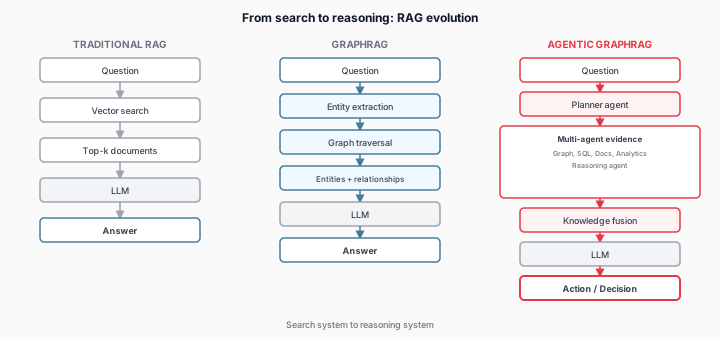
Traditional RAG vs GraphRAG vs Agentic GraphRAG
Traditional RAG
Question
   |
Vector search
   |
Top-k documents
   |
LLM
   |
Answer
Fast to ship, weak on multi-hop reasoning. Similarity is not causality; the model may miss the one document that connects student attendance to placement policy if it embeds differently from the question.
GraphRAG
Question
   |
Entity extraction
   |
Graph traversal
   |
Relevant entities + relationships
   |
LLM
   |
Answer
GraphRAG adds structure: extract entities from the question, walk the graph for neighborhoods and paths, and feed relationship-aware context to the LLM. Better for "who teaches course X?" and "which departments share faculty?"—still largely a single pipeline, not a planner with tools.
Agentic GraphRAG
Question
   |
Planner agent
   |
Multiple agents
   |-- Graph search agent
   |-- SQL agent
   |-- Document agent
   |-- Analytics agent
   '-- Reasoning agent
   |
Knowledge fusion
   |
LLM
   |
Action / decision / answer
Here the system plans. A planner decomposes the question into sub-tasks; specialist agents retrieve graph paths, run SQL against operational stores, pull supporting documents, and compute aggregates. A reasoning agent merges signals into a risk score, recommendation, or intervention plan—with provenance for each input.
What the knowledge graph contains
Instead of storing chunks only, the graph stores the business as connected objects. Consider an educational platform:
- Student A enrolled in Course X
- Course X taught by Faculty Y
- Faculty Y belongs to Department Z
- Department Z has placement rate 92%
As structured graph data—not four isolated sentences in a PDF.
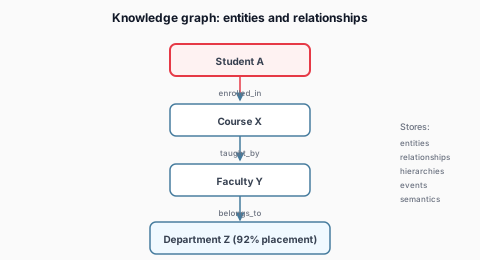
A production knowledge graph typically holds:
- Entities — students, courses, faculty, departments, companies, job roles, assessments, skills
- Relationships — enrolled_in, taught_by, develops, required_for, offered_by, measures
- Hierarchies — department → school → institution; skill → competency framework
- Dependencies — prerequisite courses, certification paths, hiring pipelines
- Events — assessment submissions, attendance marks, placement interviews, intervention triggers
- Business semantics— policies, thresholds, and rules attached to object types (what "at risk" means in your ontology)
Vector indexes remain valuable for unstructured text—syllabi, rubrics, employer job descriptions. The graph anchors retrieval: agents know which documents and rows matter before they embed a query.
What the agentic layer does
Agents decide how to answer—not just what text to retrieve. Example question:
Which students are at risk of placement failure?
A planner might orchestrate:
- Get student profile (graph + SQL)
- Get attendance records (SQL / events)
- Get assessment scores (SQL)
- Get placement history (graph traversal)
- Get skill gaps (graph: course → skill → job role)
- Get market demand signals (document + analytics agent)
Different agents fetch different evidence. The reasoning agent combines:
Attendance      = 62%
Assessment      = 55%
Python skill    = Weak
Communication   = Weak
-------------------------
Risk score      = HIGH
The output is not only an answer—it can trigger an intervention workflow: notify mentor, assign learning path, schedule mock interview. That is the shift from chatbot to operational AI.
Palantir-like architecture: ontology at the center
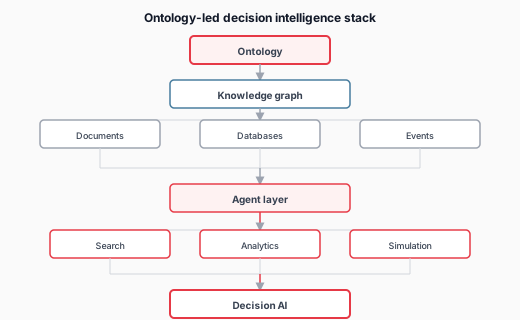
This pattern closely mirrors Palantir Foundry's ontology-led stack—and the direction Microsoft Fabric IQ and similar platforms take: business objects defined once, bound to data, acted on by agents.
              Ontology
                  |
                  v
          Knowledge graph
                  |
    +-------------+-------------+
    |             |             |
Documents    Databases      Events
    |             |             |
    +-------------+-------------+
                  |
            Agent layer
                  |
      +-----------+-----------+
      |           |           |
   Search     Analytics   Simulation
                  |
                  v
            Decision AI
The ontology defines object types, properties, allowed actions, and policies. The graph is the live digital twin. Documents and events hydrate it; agents read and write through governed action types. For a deeper treatment of ontology patterns on the Microsoft stack, see our Ontology AI consulting perspective.
Educational and skilling platforms: a concrete graph model
For workforce skilling, university, or corporate learning platforms, entity types might include:
- Student · Course · Faculty · Department · Assessment · Skill · Placement · Company · Job Role · Learning Path
Relationships encode how the domain actually works:
- Student → enrolled_in → Course
- Course → develops → Skill
- Skill → required_for → Job Role
- Job Role → offered_by → Company
- Student → completed → Assessment
- Assessment → measures → Skill
With that graph in place, the same platform supports progressively harder question classes:
- Descriptive — Which students failed Python?
- Diagnostic — Why did placements drop in Department Z this quarter?
- Predictive — Which students are likely to fail placement?
- Prescriptive — What learning path should Student A follow to become a Data Engineer?
- Autonomous — Create and assign intervention plans for all high-risk students, subject to policy approval.
Each level requires more structure, better graph quality, and stronger agent governance—not a larger context window.
The next evolution: decision intelligence, not chat
Threads across ontology AI, decision AI, and domain platforms (education, manufacturing, financial services) converge on the same stack:
- Agentic RAG — orchestrated retrieval and tool use
- Knowledge graph — structured enterprise memory
- Ontology — shared business language and governed actions
- Reasoning agents — fusion, scoring, explanation
- Simulation engine — what-if before commit
- Decision AI — recommendations and workflows with audit trails
For deep skilling or institution-wide future-skills programs, this architecture can act as the operating layer behind advising, placement, curriculum design, and employer matching—not a chat box on top of spreadsheets. Students and administrators get answers; the institution gets a system that senses risk, proposes paths, and executes interventions within policy.
Implementation discipline
Teams that succeed treat extraction, ontology design, and agent scope as product work—not weekend experiments.
- Model the domain first — entity and relationship catalog with owners; align to how operators already speak (see ontology extraction choices).
- Bind sources with lineage — LMS, SIS, HRIS, and document stores feed the graph with ACLs preserved.
- Keep vectors complementary — RAG for prose; graph for joins, paths, and rules.
- Agent boundaries — read-only analysts vs action agents with human-in-the-loop for writes.
- Evaluate by decision quality — golden questions per tier (descriptive → autonomous), not BLEU or vibe checks.
Agentic RAG without a trustworthy graph recreates hallucination at scale—with extra steps. The graph without agents is analytics for experts only. Together, they form an enterprise decision intelligence platform that happens to speak natural language.
Engineering and research perspective from the CognitiveBricks team. Practices evolve quickly; validate approaches against your security, license, and compliance requirements.